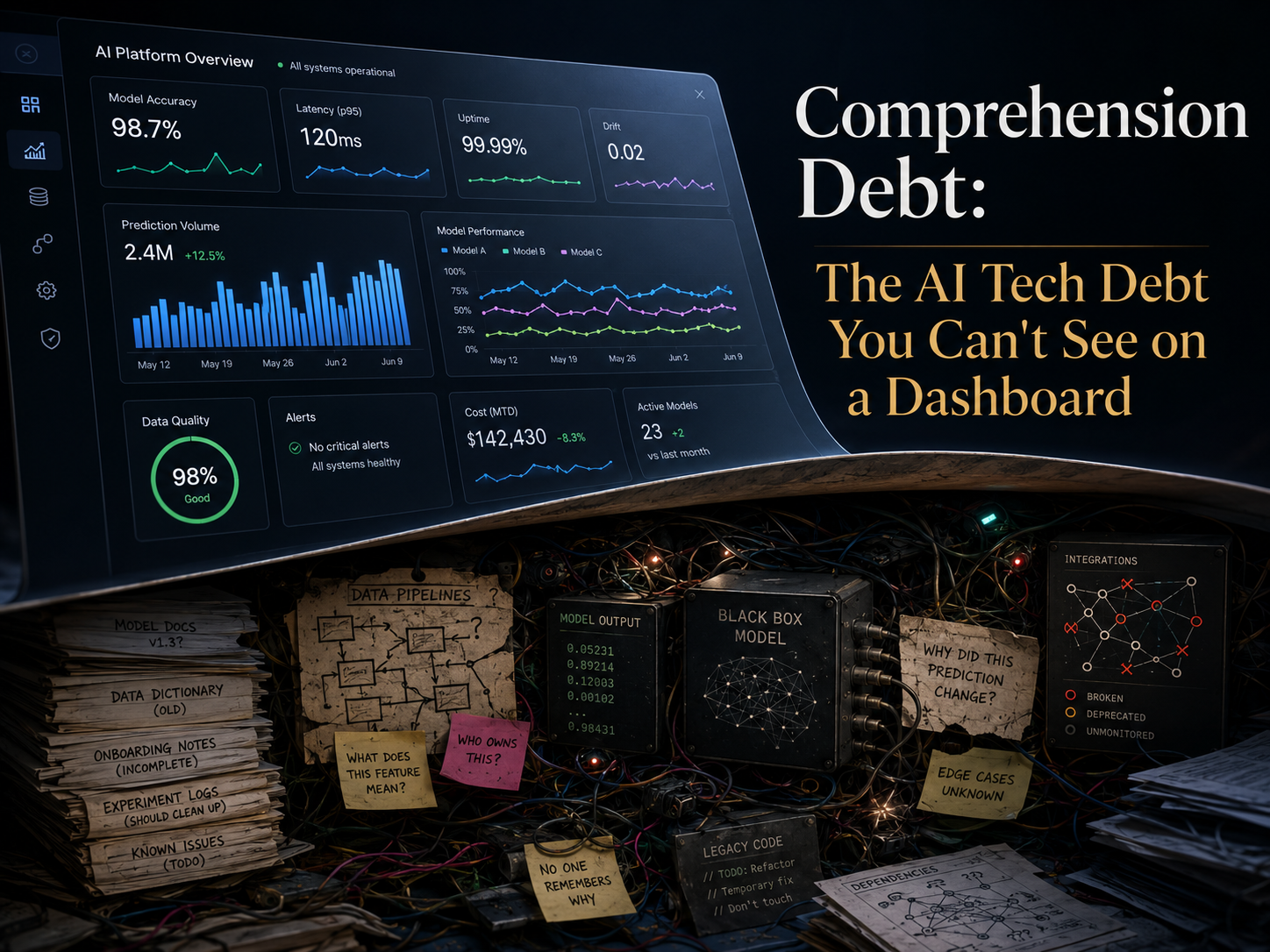
Comprehension Debt: The AI Tech Debt You Can’t See on a Dashboard
2026-06-22 · Technology · 9 min read · @TechScribeWire
There’s a specific kind of dread that has nothing to do with a bug.
You open a file. It works. The tests are green; it shipped months ago, and nobody has touched it since. And you sit there for a few minutes, scrolling, waiting for it to make sense the way code usually does once you’ve stared at it long enough.
It doesn’t.
Not because it’s badly written. The naming is fine. The structure is plausible. It just has no author. Nobody on the team remembers writing it, nobody remembers reviewing it properly, and the person whose name is on the commit moved teams in March. The code is in production, customers depend on it, and the sum total of human understanding of how it actually works is roughly zero.
That feeling is the symptom. The disease needs a name, so here’s one.
Comprehension debt Technical debt, the way Ward Cunningham meant it, is a deliberate trade. You ship the quick version now, you know it’s the quick version, and you accept that you’ll pay interest later when you have to clean it up. The defining feature is that someone chose it. There’s a decision behind it, usually a reason, often a Jira ticket. You can find the debt because you remember taking it on.
Comprehension debt is different, and it’s worse, because nobody chose it.
It’s the gap between the code that exists in your repository and the code your team actually understands. Every line that runs in production but lives outside anyone’s mental model is a unit of comprehension debt. It doesn’t show up as a defect. It shows up as hesitation — the pause before someone agrees to change a file, the meeting where four engineers admit they’re not sure what happens if they touch the billing module, and the estimate that triples for no reason anyone can point to.
Regular tech debt is a loan you signed. Comprehension debt is a loan that was taken out in your name while you weren’t looking.
Why AI is the accelerant Code has always been written faster than it’s understood. That’s not new. What’s new is the size of the gap.
When a human writes a function, understanding comes baked in. The act of writing is the act of understanding—you had to reason about the problem to produce the solution, and that reasoning lives in your head afterwards. Slow, but the comprehension came free with the code.
AI breaks that bundle. The code arrives without the reasoning. You get a working block of fifteen, fifty, or two hundred lines, and the understanding that would normally accompany it was never generated by a human at all. It was generated by a model, and the model doesn’t stick around to answer questions. You can accept the suggestion in under a second. Building the mental model of what it does takes the same twenty minutes it always did. Most people, under deadline, skip the twenty minutes.
Multiply that across a team, across a year, and you get a codebase where the volume of code has decoupled from the volume of understanding. The repo grows. The comprehension doesn’t.
This isn’t a hunch. The data showed up before most of us had a word for it.
What the numbers are actually measuring GitClear analysed 211 million changed lines of code across 2020 to 2024 — private repos and big open-source projects — and the shape of the change tells the story plainly.
Copy-pasted code went from 8.3% of changes in 2020 to 12.3% in 2024. “Moved” code — the signature of refactoring, of someone pulling a repeated thing into one reusable place — collapsed from around 25% in 2021 to under 10%. In 2024, for the first time, copy-pasted lines outnumbered moved lines. Duplicated code blocks of five lines or more jumped roughly eightfold in a single year.
Read those three numbers together and you’re not looking at a quality problem in the usual sense. You’re looking at comprehension debt being manufactured at scale.
Refactoring is how a team encodes its understanding into the code. When you consolidate three near-identical functions into one, you’re not just tidying — you’re stating, in a form the next person can read, "These things are the same thing.” That’s an act of comprehension made durable. The collapse of moved code means that act is happening less and less. The rise in duplication means the opposite is happening: the same logic scattered across the codebase in slightly different forms, each copy a small island nobody owns, each one a place where a future fix will land in one spot and miss the other four.
Churn tells the same story from another angle. GitClear found the share of code reverted or rewritten within two weeks of being committed roughly doubling against the pre-AI 2021 baseline. Code that gets ripped out two weeks after it’s written is code that was pushed before anyone understood it. The churn isn’t a measure of bad luck. It’s a measure of understanding arriving late.
The productivity number that lies Here’s where it gets uncomfortable, because the dashboard says everything is fine.
DORA’s 2024 State of DevOps report — Google’s, the one that’s been the gold standard for measuring delivery performance for a decade — found that a 25% increase in AI adoption correlated with a 7.2% decrease in delivery stability and a 1.5% dip in throughput. At the same time, around three-quarters of developers reported feeling more productive. Both things are true at once. People feel faster, and the system gets less stable.
DORA’s own read on why the part is worth tattooing somewhere: writing code was never the bottleneck. AI makes it trivially easy to produce more code, which means bigger changesets, and bigger changesets have always carried more risk. The constraint in shipping reliable software was never typing speed. It was understanding – understanding the system well enough to change it safely. AI optimised the one step that was already cheap and quietly taxed the one that was already expensive.
Roughly 39% of those developers said they didn’t actually trust the AI-generated code they were shipping. They shipped it anyway. That gap — between “this is in production” and “I’m confident in this” — is comprehension debt, measured directly, with a percentage attached.
DORA renamed its 2025 report the State of AI-Assisted Software Development. The whole industry’s measuring instrument repositioned itself around this. That should tell you the gap isn’t a rounding error.
Why it doesn’t show on a dashboard Now the central problem. None of your existing metrics are built to see this.
Velocity looks healthy — arguably better, because more code is moving. Test coverage holds, because AI is happy to generate tests too. Deployment frequency is fine. Cycle time is fine. Every green light on the wall is genuinely green. Comprehension debt is invisible to all of them because it isn’t a property of the code. It’s a property of the relationship between the team and the code, and nobody instruments that.
It stays invisible right up until the day someone has to change the unowned file. Then it converts, all at once, into something you can feel: the estimate that balloons, the change that gets routed around instead of through, and the senior engineer quietly designated as the only person allowed near the payments service because they’re the last one who understands it. The bus factor dropped to one, and nobody filed a ticket about it.
This is why Forrester’s prediction lands harder than the usual analyst noise. They expect 75% of technology decision-makers to be sitting on moderate-to-high-severity technical debt by 2026, driven specifically by the complexity AI is adding to their systems. Their proposed fix is more tooling — triple the AIOps spend. Maybe. But you can’t buy your way out of a problem your dashboard can’t even render. Tooling that watches your infrastructure won’t tell you that four engineers are scared of the same module.
What this actually costs The interest on comprehension debt compounds in a particular way. Each file nobody understands makes the next change near it slower, because now you’re reasoning about something opaque on top of something else opaque. The unowned regions of the codebase grow, and the team’s instinct is to route around them — build the new feature in a fresh corner rather than touch the scary part. Which generates more code, more surface area, and more places for understanding to go missing. The mess moves faster, exactly the way bad automation always makes a bad process faster.
The end state isn’t a crash. It’s paralysis. A codebase that runs fine and that nobody dares to evolve. You can ship around it for a surprisingly long time, which is precisely what makes it dangerous — there’s no alarm, just a slow rise in the cost of every change until someone senior says, "We should probably rewrite this” about a system that’s two years old.
What to do instead The answer is not “stop using AI". That ship sailed, and it was the right ship. The answer is to treat comprehension as a step in the process again, rather than a thing that used to come free.
Three concrete shifts.
Review for understanding, not just correctness. A green test suite proves the code does what the test says. It proves nothing about whether a human can change it next quarter. The reviewer’s job, in an AI-assisted team, is no longer “is this right” — the model is often right. It’s “do I understand this well enough to own it.” If the answer is no, the review isn’t done, no matter how clean the diff looks.
Make someone own every merge. Not the model. A person, by name, who can sit in a room and explain what the code does and why it’s shaped that way. If nobody can do that, the code isn’t ready, regardless of whether it passes. Ownership is the thing AI quietly removed from the workflow, and it has to be put back deliberately.
Spend the refactoring budget on purpose. GitClear’s numbers say teams have largely stopped consolidating. That’s the lever. Time spent pulling duplication back into shared, understood, named components is time spent paying down comprehension debt directly — turning four copies nobody owns into one thing somebody does.
None of this is exotic. It’s the discipline that used to be implicit because writing the code forced it on you. AI removed the forcing function. So you have to add it back on purpose or watch the gap between your repo and your team’s understanding widen on a graph you don’t have.
The teams that win the next few years won’t be the ones that generated the most code. They’ll be the ones who still understand what they shipped.
The first step is knowing how big your gap actually is — and that’s exactly what a dashboard won’t tell you.
That’s what we built the TechScribeHub AI Clarity Audit to do. We map where comprehension debt has accumulated in your codebase: the files nobody owns, the duplication that’s quietly multiplying, the modules your team routes around. Then we hand you a plan to pay it down before it turns into the rewrite nobody budgeted for.
If you’re shipping more AI-assisted code than your team can confidently explain, find out where the gap is hiding. Start at techscribehub.com.
Sources GitClear, AI Copilot Code Quality: 2025 Research (211M lines analysed, 2020–2024) — https://www.gitclear.com/ai_assistant_code_quality_2025_research DORA / Google Cloud, 2024 Accelerate State of DevOps Report — https://dora.dev/research/2024/dora-report/ Forrester, Technology & Security Predictions 2025 — https://www.forrester.com/press-newsroom/forrester-predictions-2025-tech-security